

A Classic Never Goes Out of Style…
October 28th, 2021 - 08:35

As those of you who follow us on social media will know, we are currently counting down to our fiftieth anniversary which takes place on 18th November 2021. As part of the celebrations, we have launched a #WLCountdownto50 campaign which looks at a variety of different memories we have from projects and events we’ve worked on over the years, as well as company landmarks. We thought this retrospective look at our history would also provide a good opportunity to look back at a few of the ‘classic’ pieces of equipment which have been released during our fifty-year history as well as examine why these fixtures are not only iconic but how they’ve also inspired a whole range of other products.
DHA Digital Light Curtain
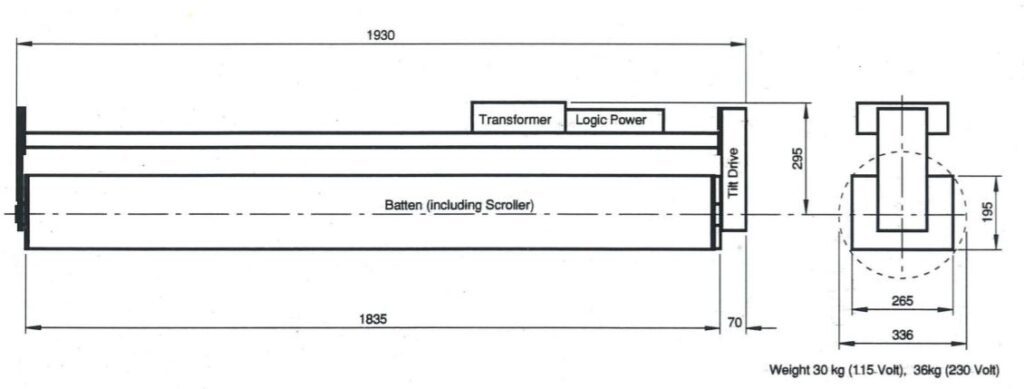
The DHA Digital Light Curtain is the result of several evolutions to the concept of a light curtain, which is essentially an intense sheet of light created using strips of narrow-angle lamps. Created by designer David Hersey and DHA Lighting’s Chief Engineer Philip Nye, the DHA Digital Light Curtain is a self-contained 8 lamp light curtain with a built-in tilt mechanism and colour scroller. The eight lamps are 12 Volt 240-Watt PAR 56 lamps wired in series, with the built in scroller holding up to twenty colours.
Before DLC, there was ‘light Curtain 560’, presumably named so as it consisted of Ten PAR56 VNSP lamps in a row. For the RSC’s Nicholas Nickleby, Hersey wanted the sheet to move, achieved by rigging the Light Curtains from two sets of fly lines, thus allowing them to tilt.
Motorising the movement was next: an electrician working on the Australian debut of Evita suggested antenna rotators: motors designed to pan radio or television aerials but with the ability to bring them back to precise, repeatable positions. Sure enough, mounting one to the end of a line of light curtains, all bolted together, meant they could move as one. For the first 10 years of Les Misérables’ run at the Palace Theatre, the lighting operator rotated a circular dial labelled with the points of the compass to move the lights to their cued positions. London’s production of Miss Saigon’s Light Curtains had Rainbow Scrollers fitted, allowing the curtain to change colour, although it could still only move as one. A New York production was quickly confirmed after the West End run and, encouraged by Bobby Fehribach, the New York production electrician, Hersey decided to try to make the product he really wanted . . . In just nine months, by early 1991, DHA Lighting’s chief engineer Philip Nye created the Digital Light Curtain. Early applications included Broadway’s Production of Miss Saigon and EFX, at the MGM Grand Hotel & Casino, an epic show, redefining Las Vegas Productions. When it premiered, it was the most expensive and largest-scaled theatre installation in the world, with the DLC being used as backlight and to add tone to the scenic elements.
At the time, it was such an innovative fixture and influenced the way designers approached lighting shows. Now, if you look at some of the most popular fixtures used in the West End, these include GLP’s FR10 and Impression X4 Bar, the Ayrton MagicBlade as well as the Elation ACL 360 Bar and Chorus Line 16. What all of these have in common is that they are, in part, inspired by the Digital Light Curtain. And whilst some products have managed to remain on the lighting rig for decades, very few have managed to influence a designer’s craft in the way which the DHA DLC has…
The Vari-Lite VL5
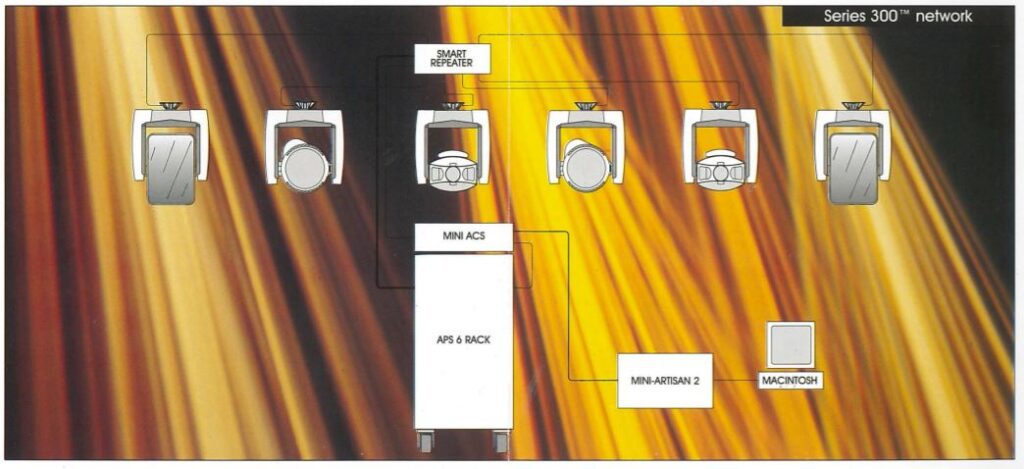
In September 1992, Vari-Lite’s Series 300 system is launched with the release of the VL5 wash luminaire. It quickly became an industry icon and was used by lighting designers across the world, largely due to its innovative Dichro*Tune™: a radial colour changer with enhanced dichroic filters which produces smooth, full colour spectrum crossfades with the fullest range in the saturated colours. Look straight into the front of the lamp and you also got to see a fabulous jeweled ‘jet engine’ effect that became an effective visual in its own right.
Fast forward to 2005 and Vari*Lite delivers an updated version of the fixture: the VL500. Launched at that year’s LDI, the fixture had a revamped motor control system, an added display with an extended remote function and onboard DMX. However, there was one thing that stayed consistent: the VL5’s distinct look. Designers, technicians, and electricians loved the aesthetics of the product, which was unlike anything that had been seen before; so much so, that further fixtures have been released with more than just a passing resemblance.
This includes the VL5 LED, which is a compact high output LED wash fixture which still retains the aesthetics of the original model it was based on, with added LEDs surrounding the front end of the fixture which light up the Dichro*fusion® blades a different color than the light coming from source engine. Similarly, the High End System TurboRay and the VL6500 Wash clearly take great inspiration from a product that was released almost thirty years ago whilst modernising the technology within and adding a unique twist of their own. TurboRay not only encompasses LED Colour-mixing, but brings additional deep red and blue dichroic, meaning the fixture can go deep while also giving a beautiful 3200 K CTO. Split colours take on a whole new dimension with independent quadrant control and whilst technology has improved, the VL5 just goes to show that, when it comes to the actual look of a fixture, change isn’t always a good thing…
Fresnel Lens
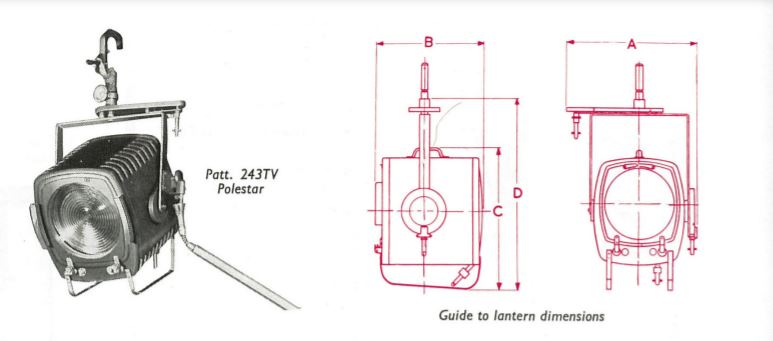
The Fresnel lens was originally designed by French physicist Augustin-Jean Fresnel back in the 18th century to be used in lighthouses, with the primary aim being ‘to save a million ships.’ These lenses have since set sail and joined the world of live entertainment where they quickly became an industry staple. Fixtures such as the Strand Patt 243 cemented the Fresnel’s place in modern theatrical lighting, with its high-intensity, soft-edged circular beam being an asset to designers. The Patt 243 was created by Morgan McLeod in 1959 and was first used on Oliver! at the Noel Coward Theatre in 1960. It soon became a standard fixture on every show, including Alpha Beta at the Royal Court which was the first show WL ever supplied back in 1972.
Strand stopped making the fixture back in 1979 but the desire to achieve the light quality that the Fresnel provided remains; and the introduction of LED, has brought about a new era of Fresnel fixtures. Whether it’s the ETC Desire, the Chauvet Professional Ovation F-415FC or the Litepanels Sola 6+ Daylight, these are all essentially updated versions of the trusty 243; albeit drawing on the latest LED technology. And whilst we fully embrace this technology for allowing the best of both worlds, the purists amongst you will be glad to know that the original 243 is still available to hire in two forms, Black, and bringing a new lease of life to the Classic Fixture, Chrome.
Heading Backstage…
For those of you who have visited WL’s Wimbledon base, you’ll know we are proud caretakers of several items from the Backstage Heritage Collection. This includes a range of lighting controllers, such as Strand’s Lightboard which was first released back in 1975. If you look at this console, what’s so interesting is that, apart from the language still used within lighting control being a direct throwback to the days of candlelight, much of the modern-day controller layouts have directly evolved from consoles such as this.
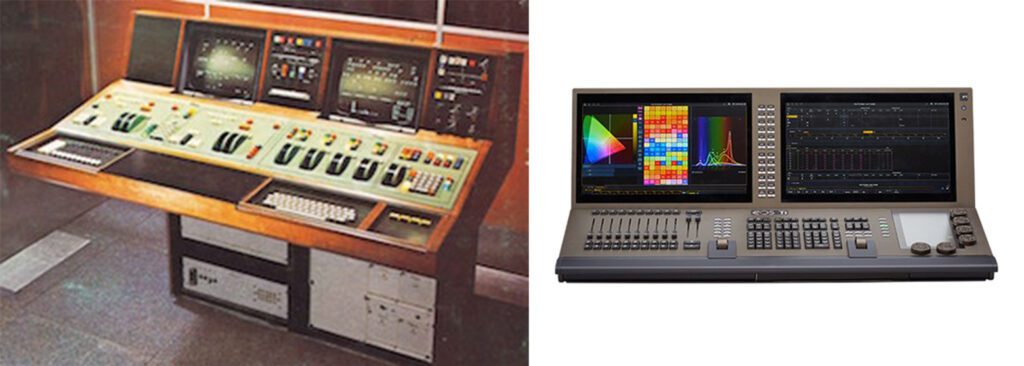
On the left, you can see an example of the Lightboard with its two screens, faders at the bottom left, numerical keypad to the right-hand side and a couple of master/group faders in between. Next to this is the ETC Eos Ti, with its two screens, faders at the bottom left, numerical keypad to the right-hand side and a couple of master/group faders in between. To say this more than resembles the Lightboard isn’t at all due to a lack of innovation. Rather, it’s still a result of decades of evolution in technology whilst staying true to a layout and structure that simply works. So, whilst the computing power within the current line of consoles is unrecognisable when compared to the throwbacks of the 70s, the essence of what’s being achieved is the same.
And we suppose that is what we’ve learnt looking back at WL’s (first!) fifty years in business. Whilst we have continuously evolved, along with our clients, peers, and technology, we still have the same aim: to find ways to support our clients in delivering projects to the highest standard and as smoothly as possible. And we can imagine that when we rewrite this article again in fifty years’ time, the products on the market by then, no matter how advanced, will share a similar ethos.