

Industry LEDing Technology; Moving Forward
May 24th, 2021 - 09:54
The launch of ETC’s Source Four LED Series 3 and Desire Fresnel marks the next step on the continual journey from tungsten to LED. In this article, we will explore in detail this gradual transition, what aspects we miss about tungsten and how the latest fixtures are helping to bring back some of its original and sought-after features.
Tungsten is a full spectrum light source, leaning towards the warmer side of the visible spectrum. It works especially well on all skin tones and it’s this generous warmth that designers love. Paired with the full spectrum, it allows not only for excellent colour rendition, but through the use of filters, can produce almost any imaginable colour of light.
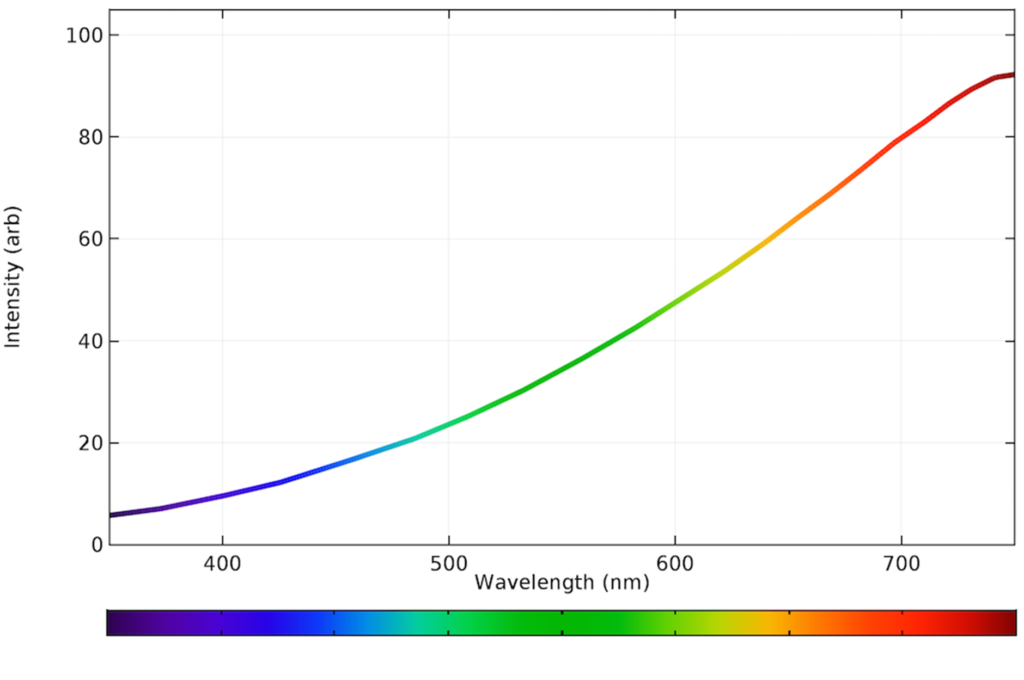
Tungsten sources have recently been the focus of a global conversation around efficiency and the sustainability. These environmental factors continue to threaten the long-term future existence of tungsten sources, be that due to regulation or an ever-shrinking market for tungsten lamp manufacture. As such, as an industry, there’s been a necessity to both adapt and move forward.
LEDs have been seen for some time as the future of stage lighting. They have many advantages over incandescent light sources, including lower energy consumption, a longer lifespan as well as improved physical robustness. Their smaller size means we can combine different colours together to allow for colour mixing which, in turn, allows for a wide range of colours and variable control of these.
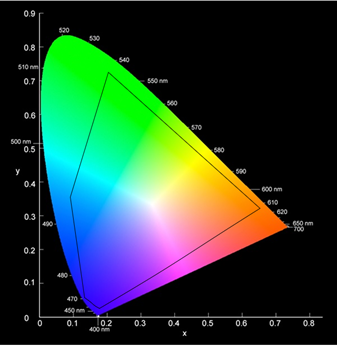
The below is a representation of the colour mixing in a simple RGB fixture within the CIE colour space. The corners of the triangle represent the red, green and blue sources, whilst the space within the triangle represents the colours that are able to be mixed using different amounts of the three sources.

It appears to do an effective job of allowing the user to mix a wide range of colours, as seen with the reds, oranges, yellows, greens, blues and purples. However, any of the hues outside of the triangle are not able to be produced and more importantly, objects that naturally appear as one of these colours, will, when illuminated by any “White Light” mixed using the RGB system, appear differently under incandescent light.
Because LED sources are not full spectrum, but instead emit a narrow band of light with one specific saturate colour, there are sections of the spectrum that are missing. The below diagram illustrates the approximate spectrum covered by RGB, overlayed on a tungsten source. Spaces between the peaks from the LEDs are missing (although some can be recreated fairly convincingly).
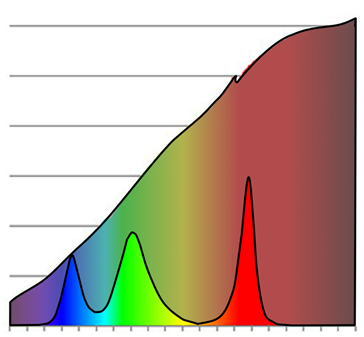
That said, in reality, we don’t just light blank, white spaces. Instead, we light areas that contain a variety of colours and, particularly when it comes to theatre, we also have to contend with the people and objects that fill these spaces. This is why the spectral content becomes so important in terms of how you want these objects to look. For example, a yellow object, such as a banana, might render differently under RGB LED as part of the yellow section of the spectrum, compared to a tungsten source. This is because there isn’t actually any of the yellow spectrum being produced. We also give up the long wavelength reds to the righthand side of the diagram. These are so important in lighting skin tones as skin is translucent and underneath the skin is blood running through veins. It’s actually the reflection from this blood that makes for a quality render of all skin tones.
If we add in more sources, we can extend our reachable colour space and fill some of the gaps in the spectrum. That’s the approach ETC has been taking for a number of years, having led the industry when it comes to LED colour mixing. In 2009, ETC acquired Selador® and its founder Fred Foster commented on how the company was looking for a “significant innovation in lighting” and that the Selador product line produced a “far superior quality of color and light to anything that we had seen before in LEDs.” The Selador® Palletta Array was made up of seven different sources: red, red-orange, amber, green cyan, blue and indigo; filling in the gaps in the spectrum missing from RGB.
This concept has been adapted over the years, swapping the red-orange chip for white in 2012’s Lustr+ LED fixture. The Source Four LED Lustr+ was brighter than any competitor and had a better-quality light, but there was still some progress to be made.
Following this, ETC then truly embodied its role as the industry leader: someone who would continue to ask challenging questions, stay abreast of the latest technology, sit on the standards committees, and push innovation in the right direction. The company was very much aware that in the race to produce a bright, energy efficient fixture, it would be easy to lose sight of the beauty of tungsten.
Released in 2014, the Lustr Series 2 was built on a growing reputation for brightness and quality. The figures showed it wasn’t as bright as a tungsten Source Four in an open environment, but this was a hard comparison to make as, for certain colours, the LED unit won an easy victory. The Source Four LED Series 2 Lustr Array also included the addition of a lime-green LED emitter. Lime green increases the luminaire’s lumen output in open white and lighter tints to make them brighter and livelier, better matching the colour of a conventional Source Four fixture. The lime also enriches colour-rendering by better marrying the red and blue ends of the colour spectrum, for truer-to-life light that fills in the gaps that other fixtures leave behind.
At the time, Lighting Designer and Programmer Rob Halliday commented: “It was immediately clear that the Series 2 was different. Set to match the ‘open white’ of tungsten, it had the same richness, warmth and life of the tungsten version. In mixed colours, it retained that life, even on the skin or complex fabrics that poorer LED fixtures rendered either flat and lifeless or with a sharp, electric feel.”
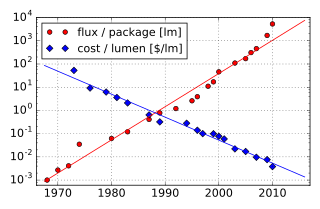
LED technology continues to become brighter, cheaper and smaller, meaning the ability for products using the technology to not only pack in more features, but to squeeze more output from the same-sized fixture. However, different wave lengths are harder to manufacture than others and, for all the benefits, the Lustr 2 still misses the long wavelength reds.
ETC’s Advance Research Group realised that if you illuminate a subject with a deeper red then the appearance on a video display was much more dramatic. Fred stated: “We have to have these in our next fixtures, even if it costs us brightness; we must have this Deep Red because we want to stake our claim to being the colour quality leader within the industry move to LED.” And true to Fred’s wishes, the Lustr X8 Color System truly set a new standard in LED lighting quality.
The array includes a patent-pending mix of green, lime, blue, indigo, cyan, amber, red and deep red LEDs. This deep red captures the subtle colours at the far edge of the visual spectrum, enhancing skin tones, sunsets, and firelight in ways you didn’t know you were missing. Even more surprising is how this same deep red also brings a new depth to deep blues, saturated greens, and ambers.

While deep red LEDs have been around for years, it’s always been a question of brightness OR colour quality. ETC has now found a way to give you a fixture that outputs a surprising number of lumens while maintaining the nuanced colour control needed. The red that we have today in fixtures from most manufacturers looks red, because all colour is relative and it was compared to sources that were more orange i.e. have shorter wavelengths. However, we have actually been missing all the longer wavelengths from our LED light sources. The standard red is around 635nm whereas the new deep red is around 660nm. 25nm doesn’t seem like a big difference given how small a nanometre is, but when you see the two on a white wall, it’s remarkable how orange the red looks next to the deep red. Lustr X8 doesn’t contain all the long wavelengths, but it’s got more of them and looks incredible as a result. Deep red is finally at a place technologically where it is bright enough to be useful and make a visual difference, in the same way the introduction of a Lime source in other ETC Arrays such as ColorSource, added a level richness to skin tone.

The X8 Array is currently found in three fos/4 Panel Lights and a 7-inch Fresnel designed for broadcast use, with two further Fresnel fixtures expected to join the Studio Line up. Source Four LED Series 3 and Desire Fresnel are the perfect pairing for any theatre, offering a smooth wash, impressive colour-mixing and ultimate brightness. With that in mind, it seems that ETC is once again pioneering new standards for the industry and giving designers looks and feels that previously weren’t possible.